
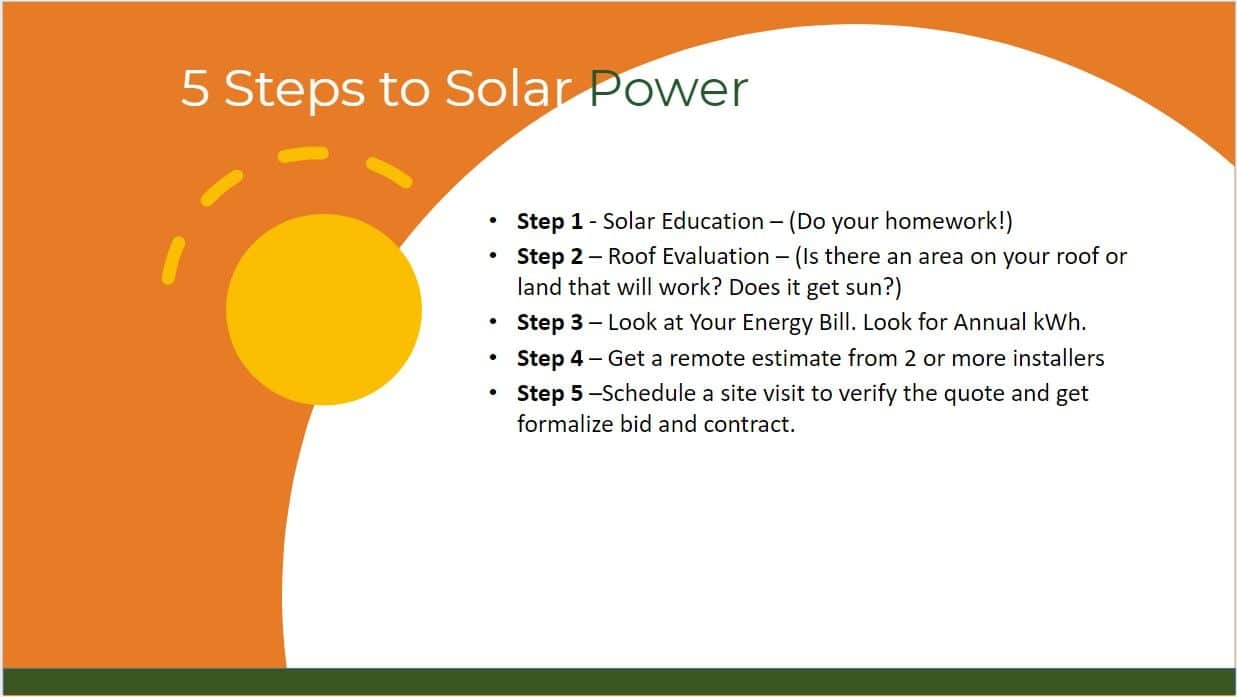
Five Steps to Going Solar for Homeowners
If you’ve already started researching how to go solar, you’ve probably been thinking about these questions. For other large purchases, a home, a car, or a home renovation, you probably know other people who have purchased those items that you could ask for advice about their experience.
While solar power is becoming a lot more common and is relatively simple, there are still a few things to know. We have created a guide at SES to help you start your journey.
How Residential Solar Works
System Components
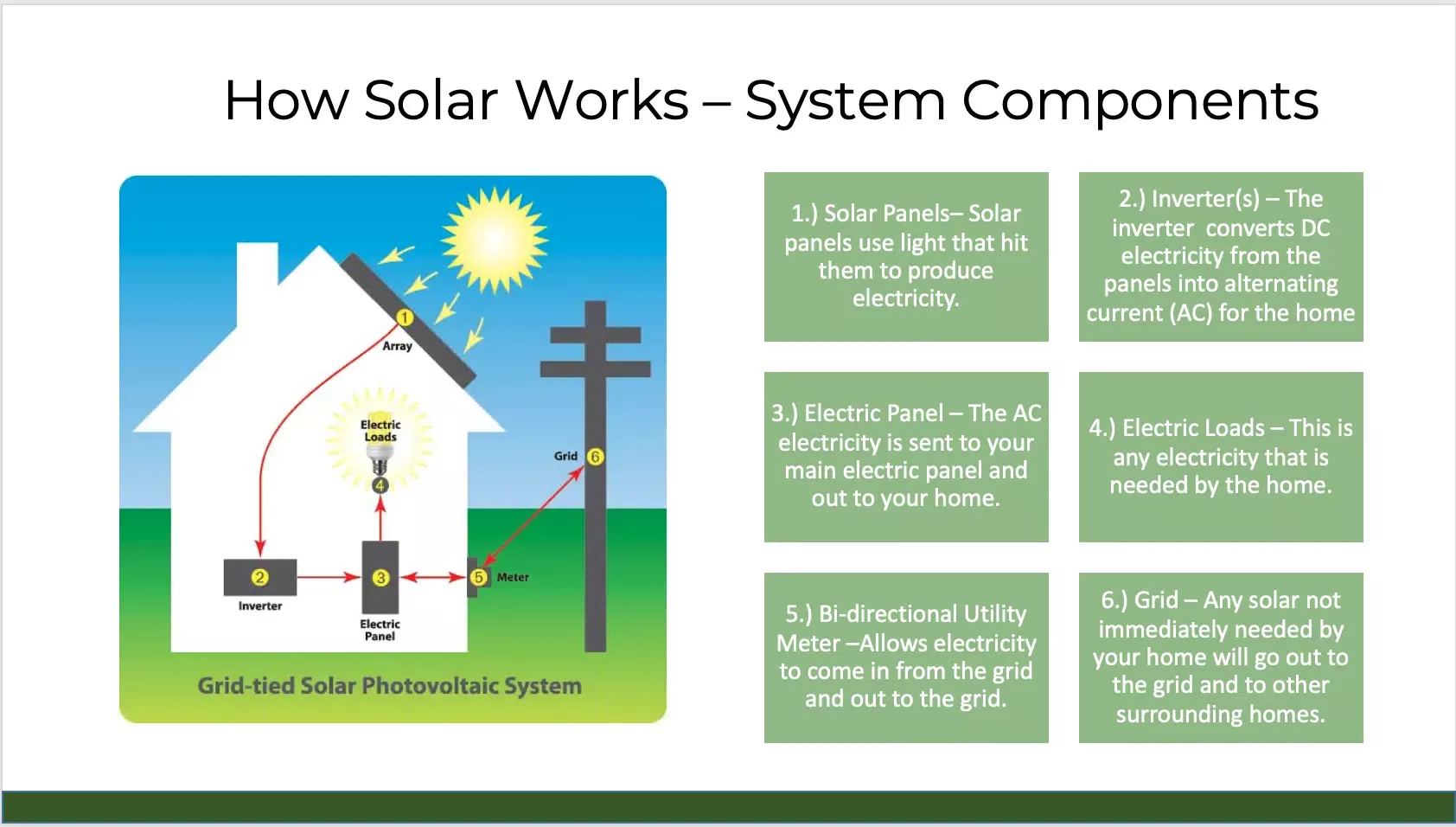
Understanding how residential solar works is a great place to start in your transition to solar power for your home. One great thing about solar is that it doesn’t have that many components, and its power is easily tracked and monitored from your computer or smartphone. Below is a simple diagram of all the parts involved in a residential grid-tied solar system.
How Solar Works from Panel to Grid
- When light hits the roof’s solar panels, it causes a chemical reaction that produces electricity.
- That electricity is converted from direct current (DC), produced by the panels, to AC needed by your home energy loads. The piece of equipment that does this is the inverter.
- The electricity flows into your main electric panel from the inverter. There it is either distributed to your home’s electric loads or the grid if not needed.
- The electric loads in your home are anything that uses electricity; your lights, appliances, computers, TV, HVAC, refrigerator, and all the things you charge, like your phone or even an EV if you own one.
- The utility meter on most homes only measures energy entering the house. At the end of every billing cycle, you are charged for all the kilowatt hours (kWh) that your home used. When you have solar, you will receive a bi-directional meter. That meter will run forwards and backward, and you will pay the difference. That is called net metering. In some places where net metering isn’t available, you will receive a credit for that power, but the amount can vary. Talk to your local consultant to be sure you understand your utility policies.
- Any power not needed by the home (or battery if present) goes out to the electric grid and will flow into other people’s houses, where it will be used for their electric loads.
Understanding Net Metering
Net Metering Explained
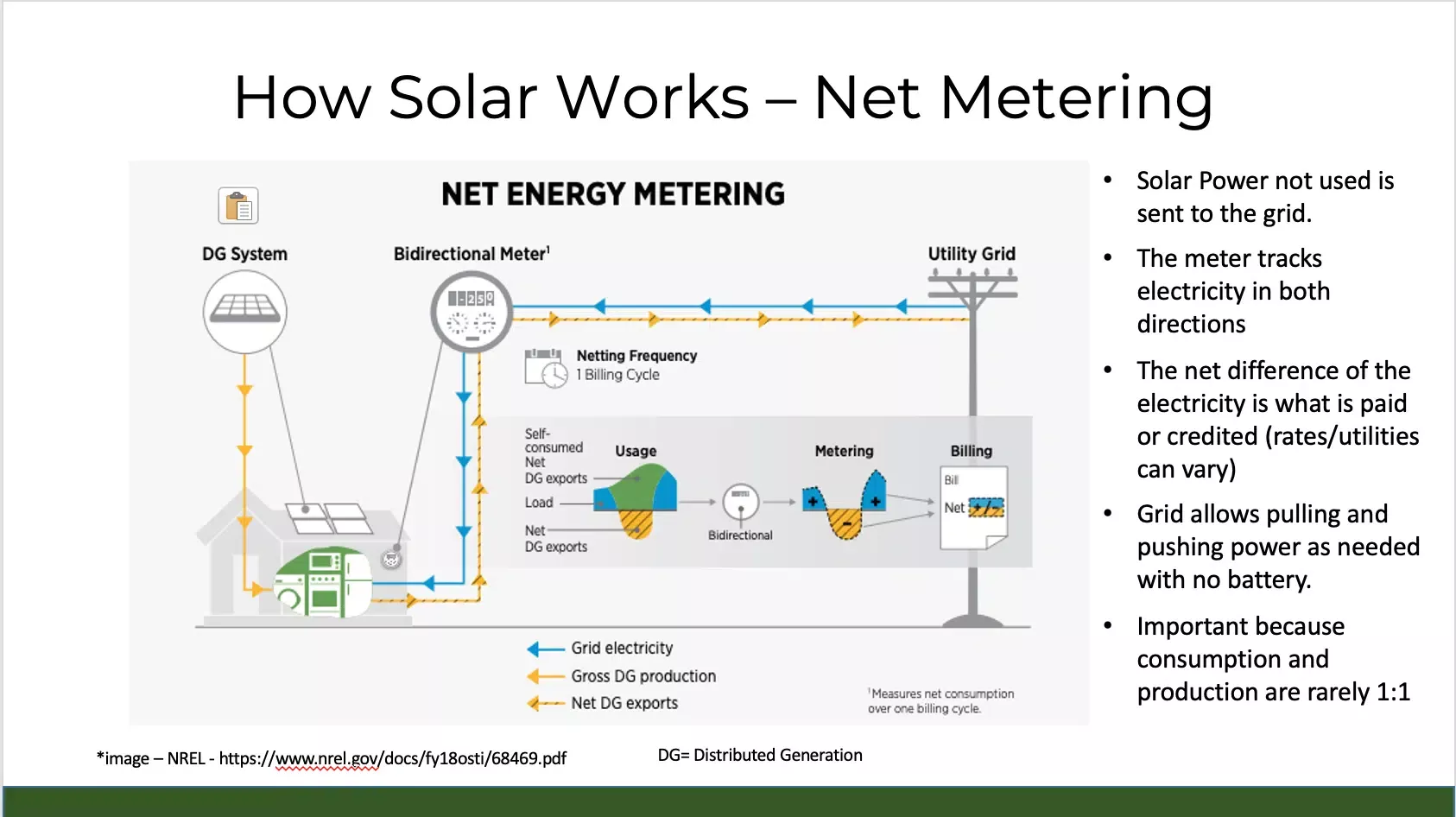
Net metering agreements are available to customers with solar panel systems in many places, with many utility companies. Solar homes tied to the grid have a bi-directional utility meter that allows energy to flow into the house from the grid. It also allows the home to send extra energy out to the grid. This extra energy is generally sent out during the day when you produce the most electricity and flows to other utility customers. When power flows out to the grid, the meter runs backward, and when energy flows into the home from the grid, the meter runs forward. At the end of the month, customers pay the difference or get a credit. Below is a good representation of net metering using an image from the National Renewable Energy Laboratory*.
POWER OUTAGE AND SOLAR BATTERY
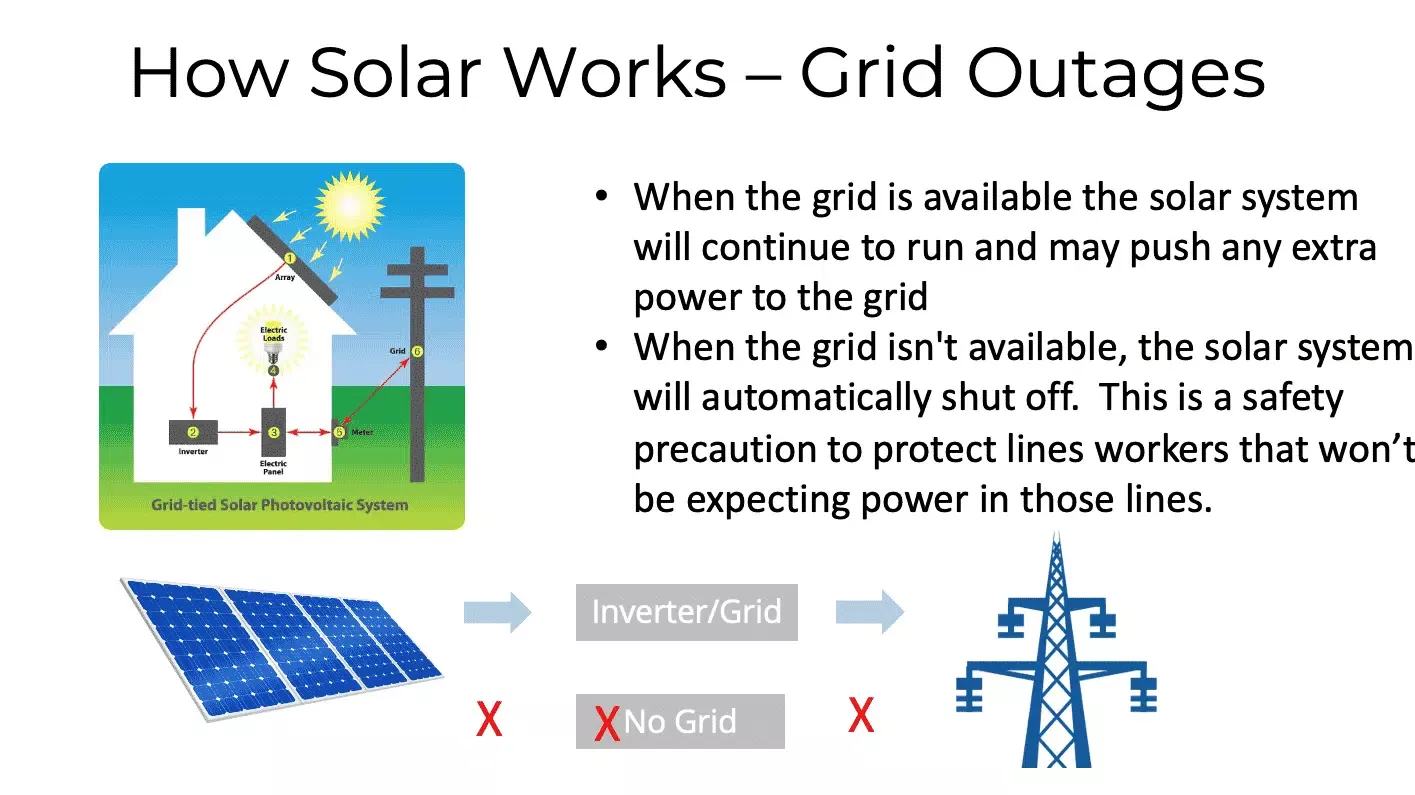
What does a power outage mean with solar and no battery?
Earlier, we learned about net metering and how it allows homes with solar power to pull electricity from the grid and PUSH electricity into the grid. Being able to export energy during times your system is overproducing (getting a credit) and pull power when you aren’t producing power, at night, cloudy days, which is excellent. However, the ability to push power into the grid means that there is the possibility that power could be pushed into electric lines that lines workers are working on without the utility knowing or having the ability to stop this power. Because of this, a safety measure is integrated into solar systems without a battery, shutting those systems down when the grid is unavailable.
What does a power outage mean with solar and a solar battery?
A power outage is quite different if you have a solar battery to store backup power. Your system will keep running in that situation, so you will not lose power. Any additional power can be sent to the battery and not the grid, so it’s safe for utility workers and convenient for you.
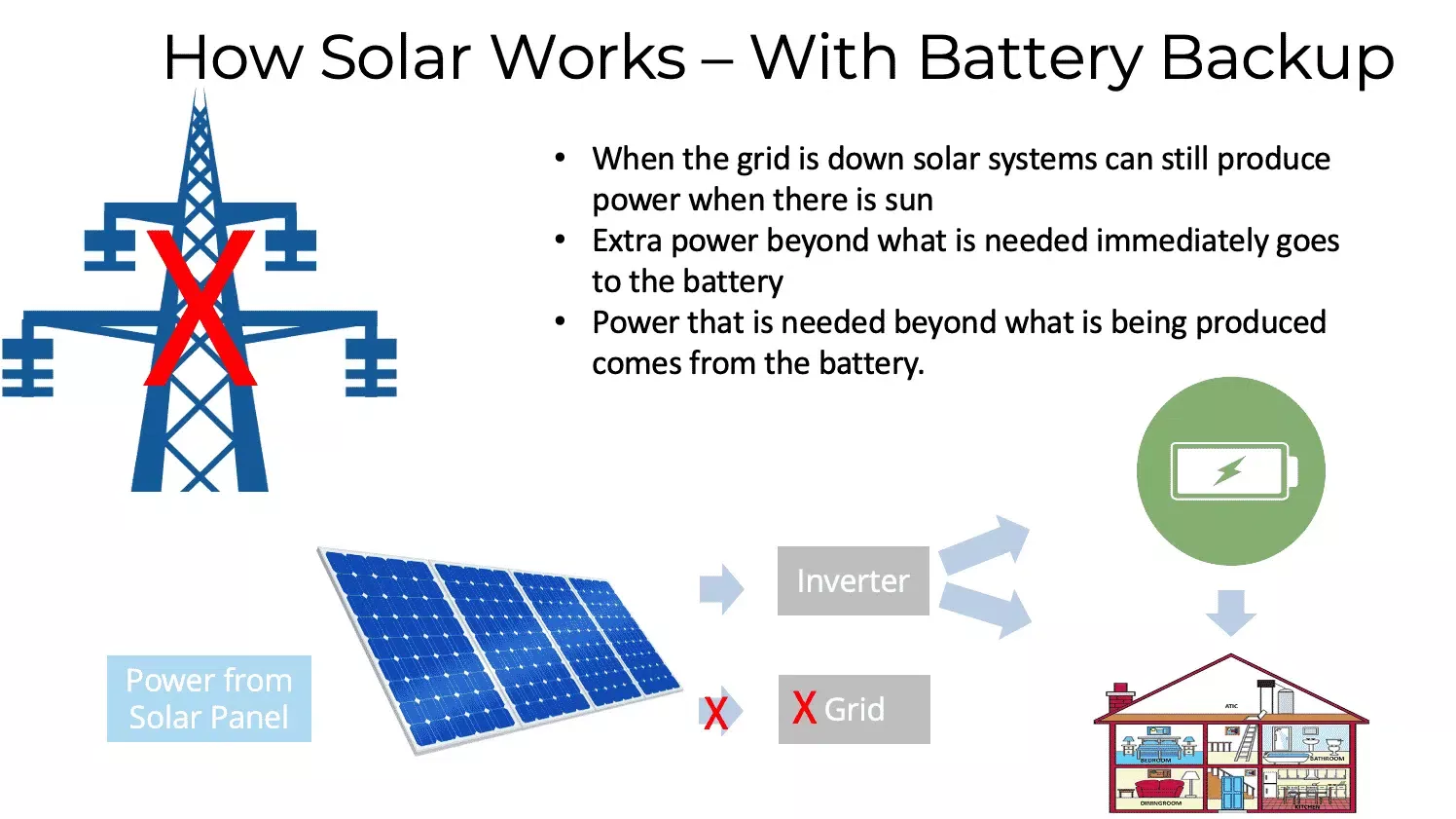
A backup battery for solar power is much like a generator, except it saves solar energy instead of being powered with natural gas or propane.
SYSTEM TYPES
Solar System Types Depend On Your Goals
Depending on your goals for solar power, there are 3 main system types to understand. Those types are grid-tied (grid-connected) systems, grid-tied with battery backup systems, and off-grid systems.
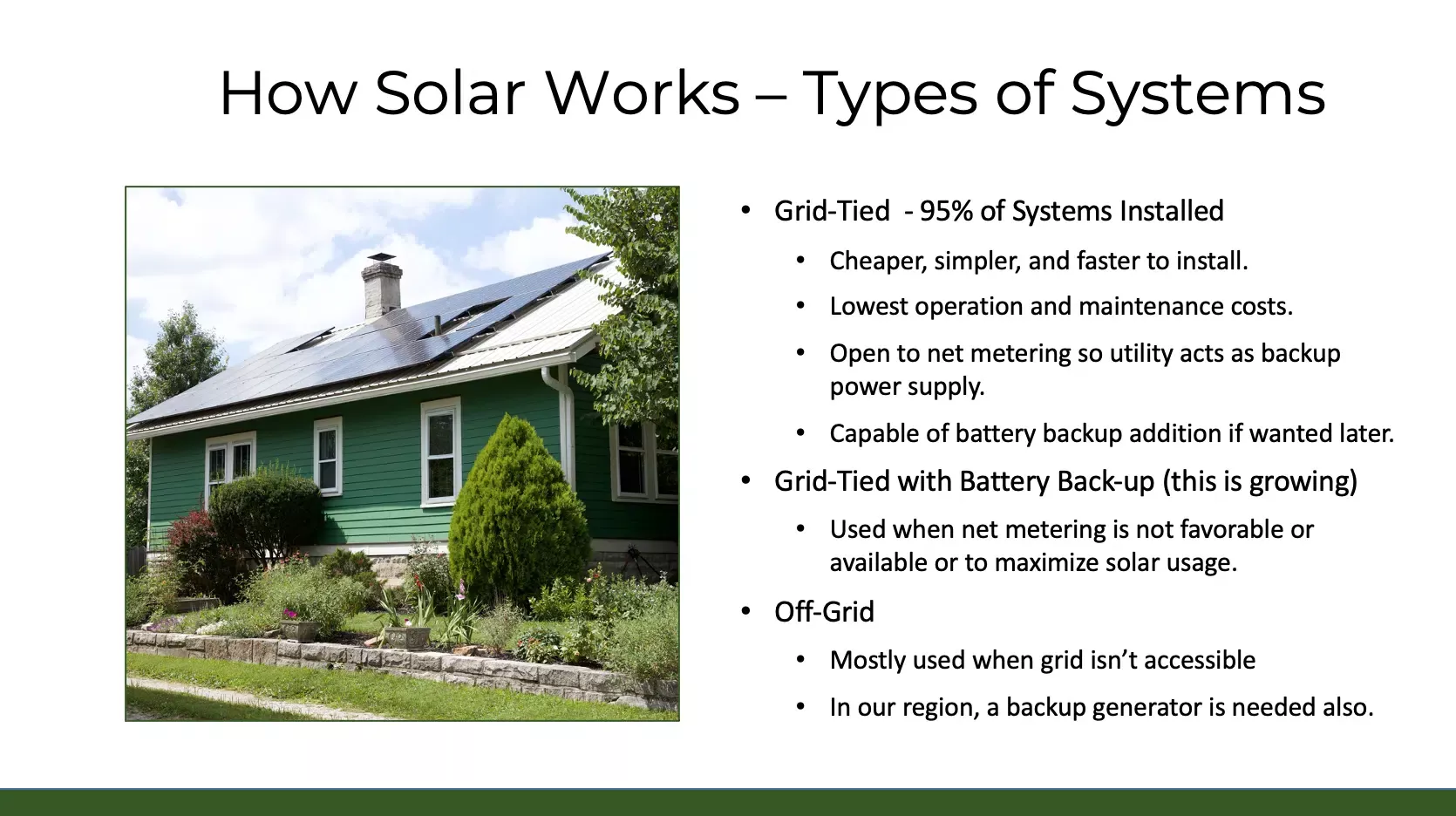
Adding a Battery to a Grid-Tied System
A solar battery is an option that you can add to a home solar system to be able to save some of the electricity that your solar system produces. That power that wasn’t used during the day can be used at night or during a power outage. Solar systems that don’t have batteries attached to them are designed to shut down automatically if the grid isn’t detected. This is a safety precaution to protect lines worker that may be working on power lines to restore power.
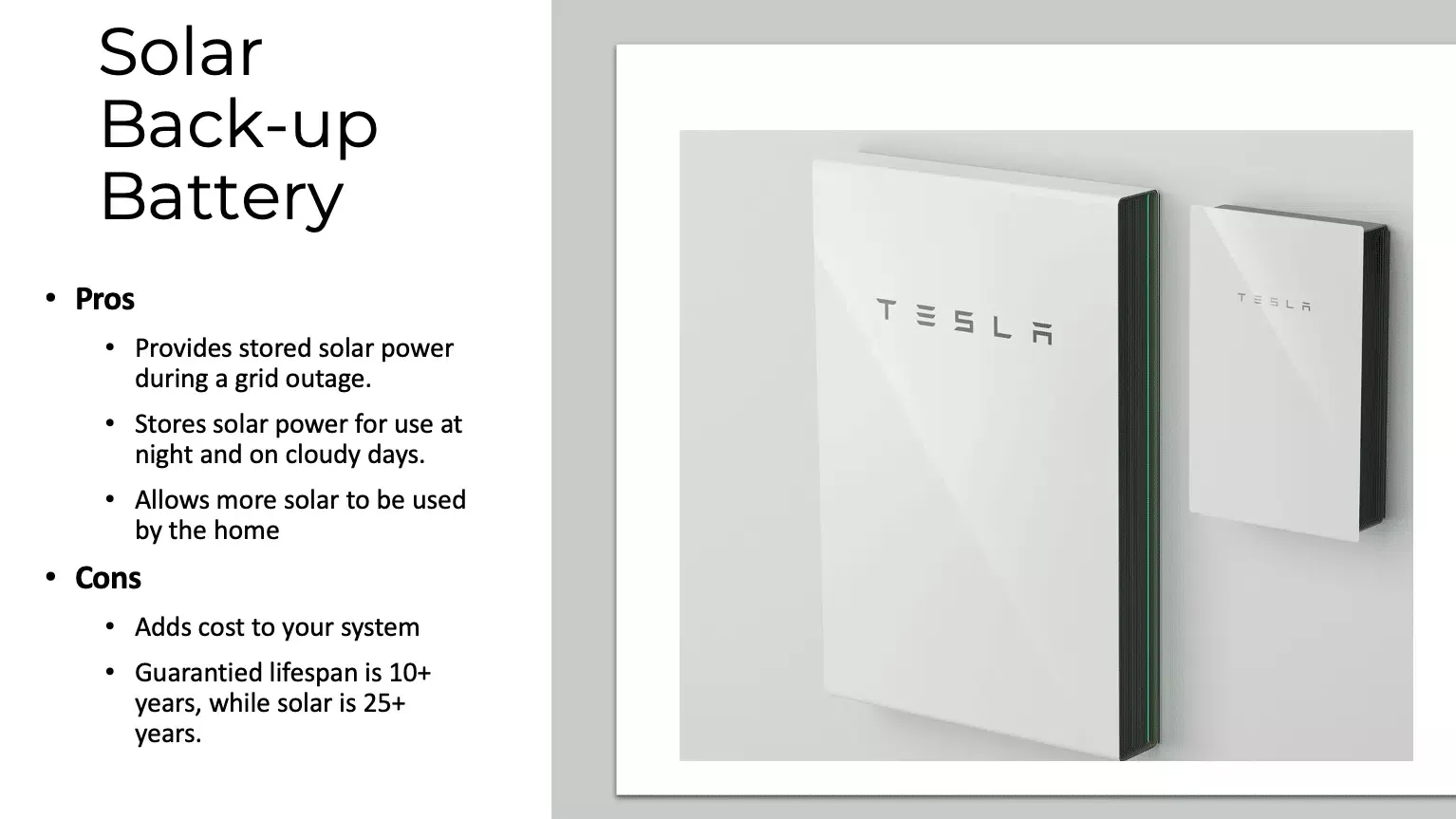
Batteries like the Tesla Powerwall 3 can be added to most solar systems to provide backup electricity. It’s really just like a generator but uses stored solar electricity instead of running on natural gas or propane.
ROOF CONSIDERATIONS FOR SOLAR
What makes a good or bad roof for solar panels?
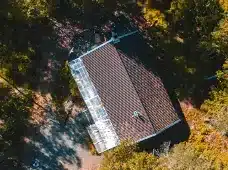
For roof-mounted solar systems, which are the most common for residential systems, there are three main things to consider: shading, configuration (complexity), and orientation (azimuth).

Shading
Orientation

Configuration
Shading
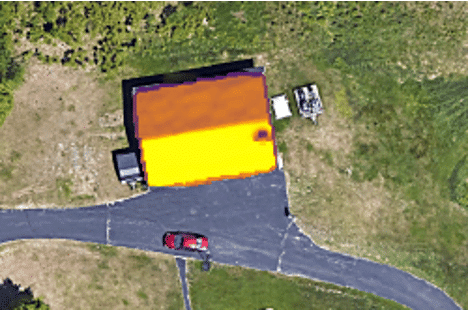
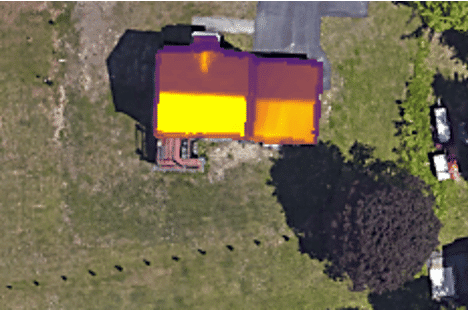
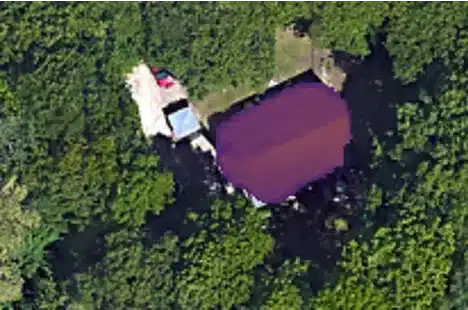
Shading is one of the most important things to look at for your roof. The images below are taken from Google’s Project Sunroof, an easy and free tool/website to find out how much sun your roof gets all year round. Below is a good look at the difference between full sun, no sun, and the middle ground.
No Shading is Ideal
Some Shading is OK
Heavy Shading is Bad
Orientation for Solar
Orientation is the direction your roof faces in relation to the sun.
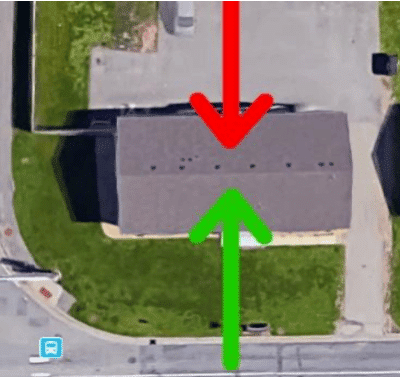
South Facing is Ideal
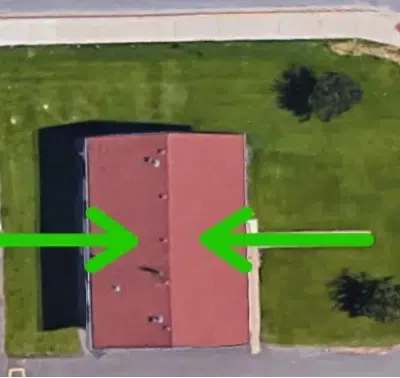
East & West are Good
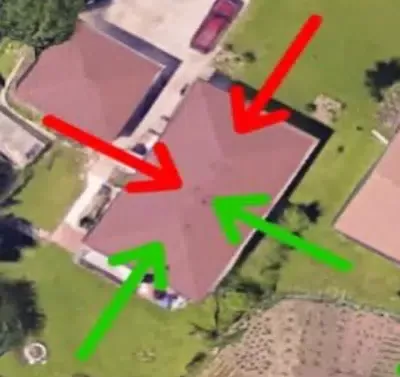
Southwest & Southeast
Roof Configuration or Complexity
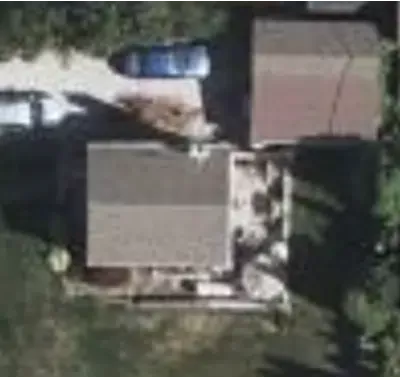
No Obstruction
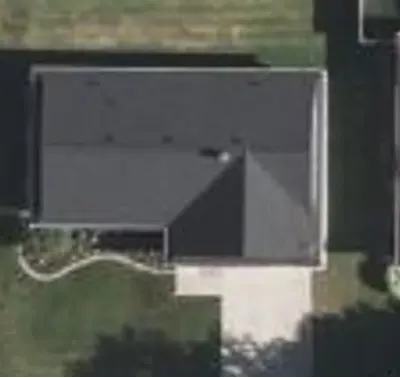
Some Obstruction
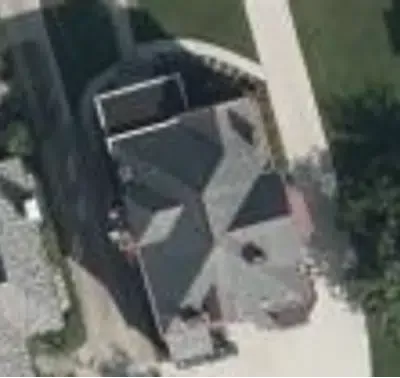
Highly Complex
what if your roof isn’t suitable for solar?
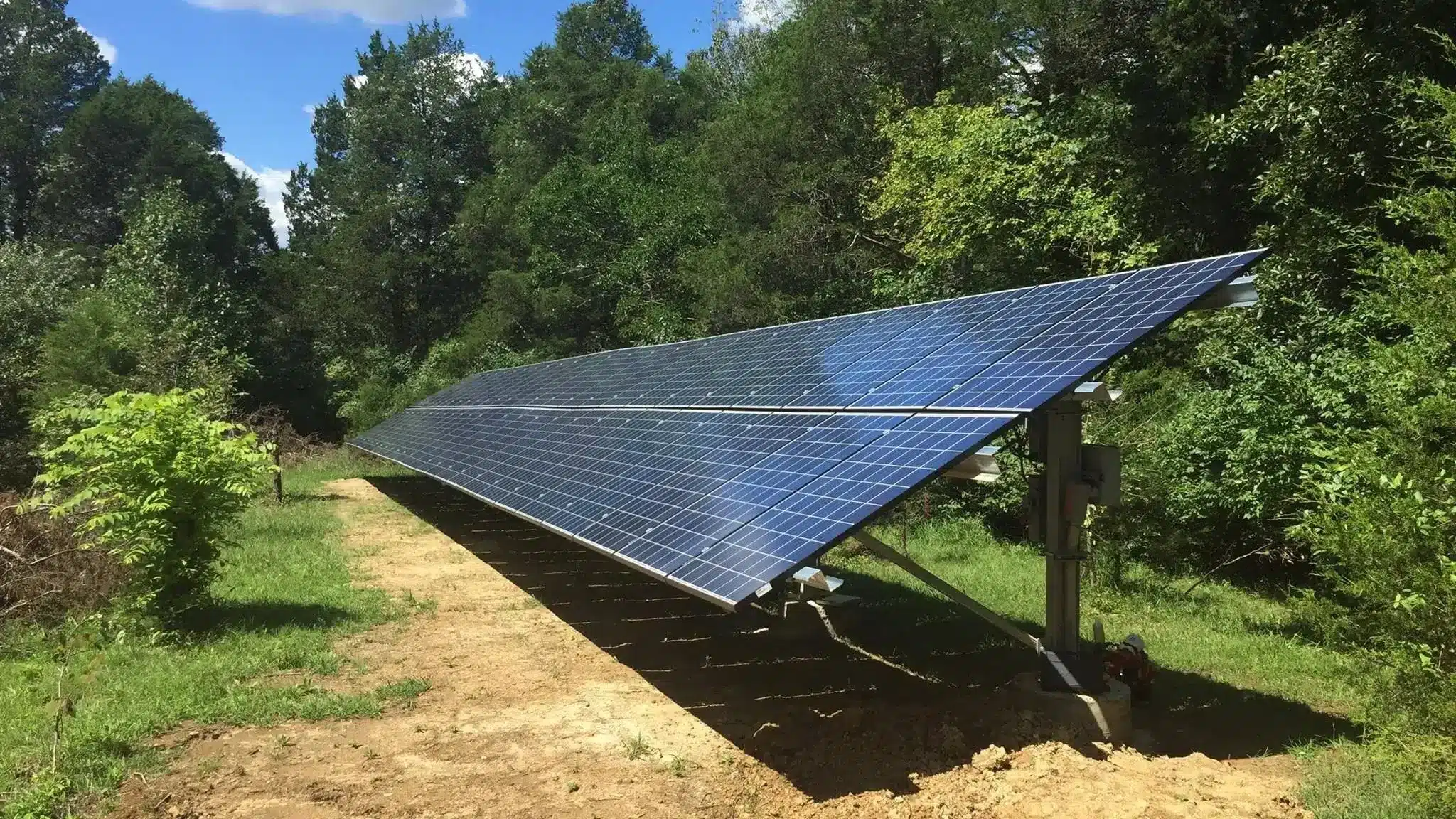
You can install a ground-mounted system if you have enough space in your yard or on your land. Learn all about these systems next.
GROUND MOUNTED SOLAR SYSTEMS
A Ground Mounted Solar System is an Option in Some Cases
Ground Mounted Solar System can be a good option when the roof isn’t ideal, and you have enough space on your property that has access to sunlight most of the day.
SIZING YOUR SOLAR SYSTEM
What size solar system does your home need?
One of the main things determining the size of your solar system is the power your home uses. The size of the system can also be limited by space, but the power your home uses will be the upper limit of how big you want a system to be. Also, you don’t have to cover all your electricity with solar; sometimes, the space for panels limits the system size.
Regardless of your goals for the amount of power you want to offset with solar, knowing how much power you are using starts with your electric bill. What you’re looking for is annual or monthly kWh.
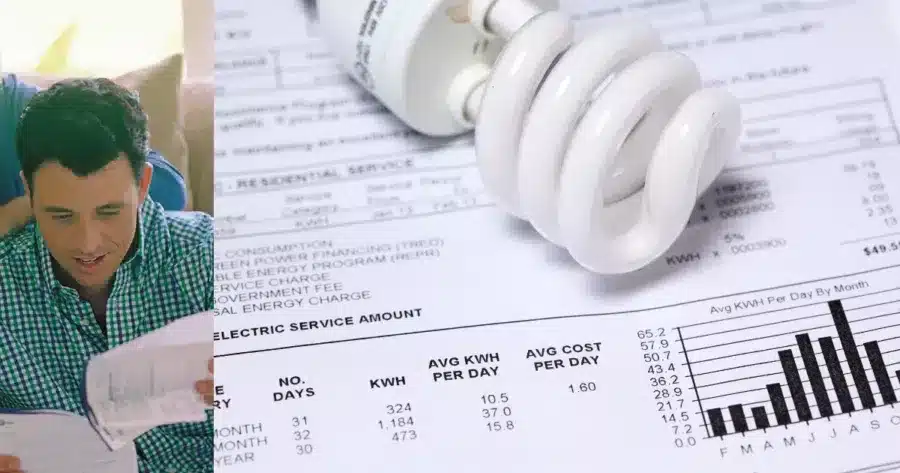
Utility bills can look different from different companies, but they will all have your electric usage on them. You are looking for the kWh, and it’s essential to know the time increment. So some bills will give you your annual kWh in one number, others will give you monthly totals for kWh, and some will give you average daily kWh usage by either month or year. The best thing to do is to provide your solar consultant with a copy of your bill. They can then build a system based on your home’s unique power usage.
Be sure to let your consultant know if you plan any significant electric load additions, like a hot tub, a pool, or an electric car.
NEXT STEPS
Remote Quote
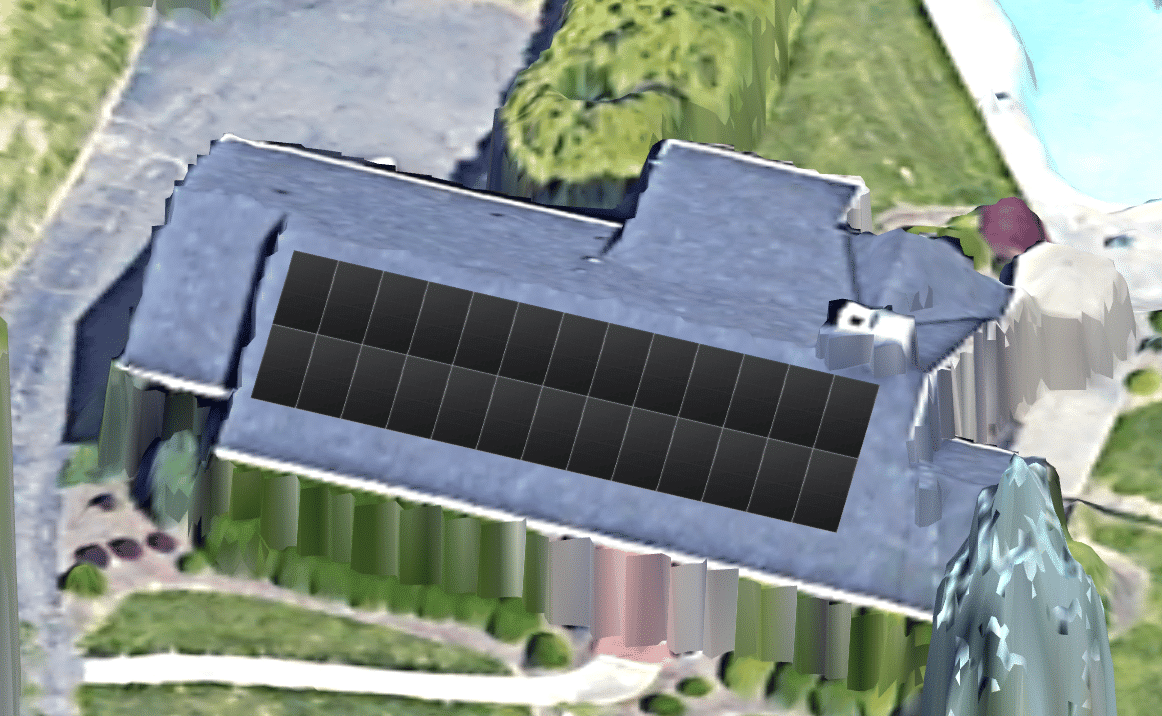
Now that you’ve determined that solar and/or battery storage is right for you, the first step is to get a remote quote. This is done with the electric usage information from a recent electric bill you will provide for your home, a satellite review of your roof and/or property, and any information you’ve shared about your goals. You will get an online quote to review, and we highly recommend talking with one of our consultants to walk through the quote. This will allow you to ask any questions and get a better understanding of your project
Site-visit
After you talk over your remote quote and you’re ready to move forward, schedule a site visit with your consultant. This is an on-site meeting at your home where your consultant will gather information from your home. This will include information about your main electric panel, roof measurements, and more. After this meeting, your consultant will fine-tune anything needed in your design and send the final proposal and contract.
Proposal & Contract
Your final proposal will look just like the remote quote, but it will include any updates that were needed after the site visit. You can sign your contract and even start financing right from your proposal if you plan to use Solar Energy Solutions’ partner Credit Human.
Click the Request a Quote button below to get started.